Related
Abstract
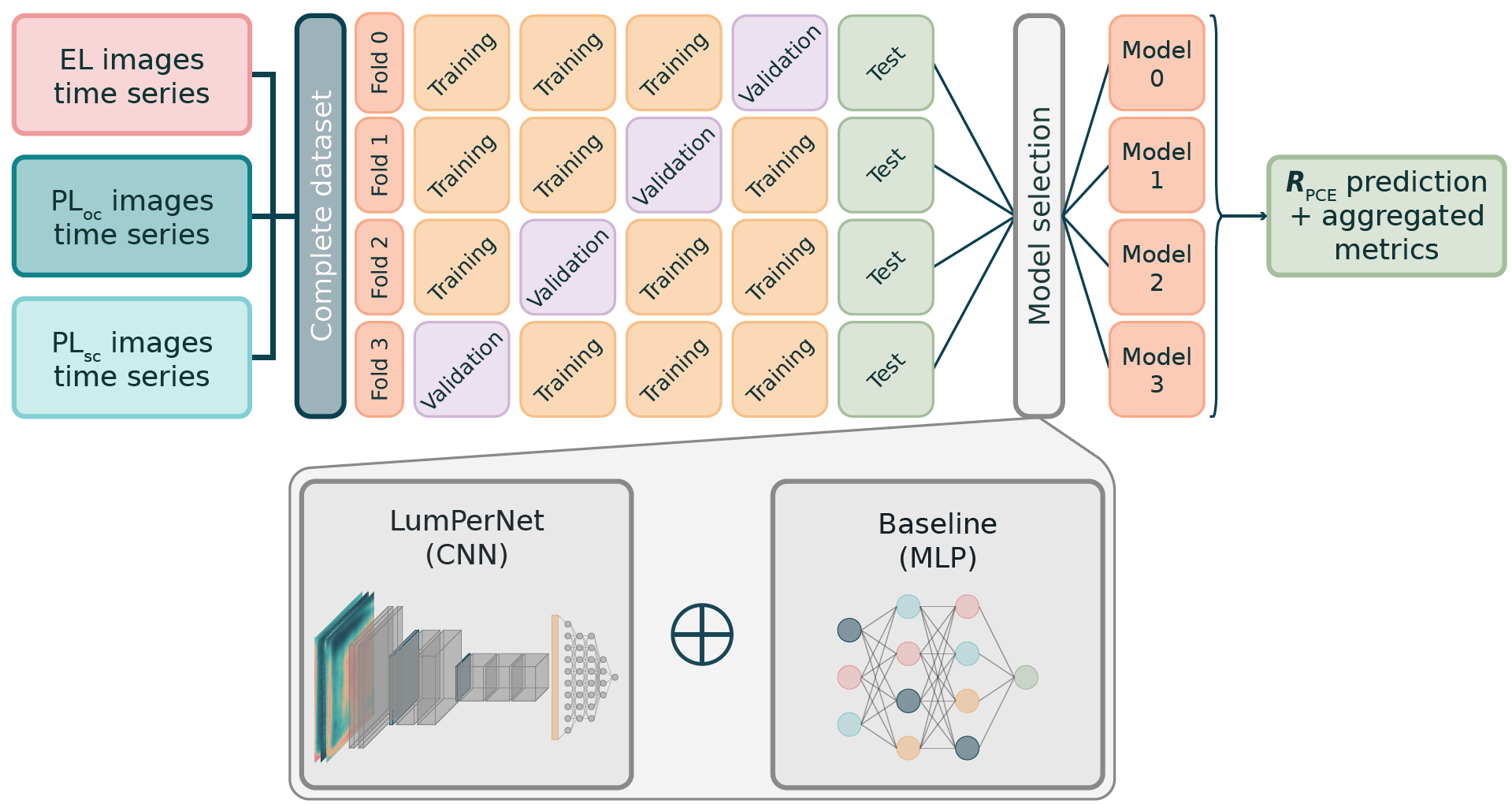
Perovskite solar cells achieve remarkable power conversion efficiencies, yet operational stability remains a major barrier to large-scale deployment. Reliable and rapid assessment of device state of health is therefore essential. Conventional electrical diagnostics, such as illuminated current–voltage (J–V) sweeps, provide accurate performance metrics but are time-consuming and do not resolve spatially localized degradation, motivating non-invasive imaging-based alternatives. Here, a deep-learning framework is introduced to estimate PSC efficiency retention, $R_\mathrm{PCE}=\mathrm{PCE}_t/\mathrm{PCE}_0$, directly from multimodal luminescence imaging acquired during device aging. Each sample combines electroluminescence (EL), open-circuit photoluminescence (PLoc), and short-circuit photoluminescence (PLsc) at an aged state with device-specific reference images at $t=0$, enabling learning of degradation-relevant spatial changes. LumPerNet, a compact convolutional neural network, is benchmarked against a spatially homogenized control in which each luminescence channel is replaced by its spatial average while retaining the same learning framework and leakage-aware protocol. The comparison indicates that global luminescence evolution contains most of the predictive signal, while spatial information provides a secondary contribution to robustness. These results establish spatially resolved luminescence imaging as a practical route for accelerated stability testing and non-invasive degradation monitoring in perovskite photovoltaics.
Figure 1: The schematic shows the protocol for training the LumPerNet models.
Citation
Barletta, Giulio, et al., Quantifying Perovskite Solar Cell Degradation via Machine Learning from Spatially Resolved Multimodal Luminescence Time Series, Solar RRL, 2026, https://doi.org/10.1002/solr.70433.
@article{barletta2026quantifying,
author = {Barletta, Giulio and Ternes, Simon and Ali, Saif and Abbas, Zohair and Ostendi, Chiara and D’Addio, Marialucia and Magliano, Erica and Asinari, Pietro and Chiavazzo, Eliodoro and Carlo, Aldo Di},
title = {Quantifying Perovskite Solar Cell Degradation via Machine Learning From Spatially Resolved Multimodal Luminescence Time Series},
journal = {Solar RRL},
volume = {10},
number = {15},
pages = {e70433},
keywords = {artificial intelligence, degradation diagnostics, efficiency retention, luminescence imaging, machine learning, perovskite, photovoltaics},
doi = {https://doi.org/10.1002/solr.70433},
url = {https://onlinelibrary.wiley.com/doi/abs/10.1002/solr.70433},
eprint = {https://onlinelibrary.wiley.com/doi/pdf/10.1002/solr.70433},
year = {2026}
}